It’s personal

“What do Lisa Olson and the Iraqi Army have in common? They both have seen Patriot missiles up close.” This notorious quote was uttered in 1991 by Victor Kiam, owner of the New England Patriots from 1988–1991.

On September 17, 1990, Olson was a reporter for the New York Daily News reporting on a New England Patriots practice. While interviewing cornerback Maurice Hurst, tight end Zeke Mowatt stood directly behind her naked and started making suggestive comments. Other players joined in.

Olson said the incident was nothing less than “mind rape”.

The NFL appointed a commission to study the incident. The commission found that the offenders were Zeke Mowatt, Robert Perryman, Michael Timpson, and the Patriots management. They were fined $47,000 in total. However, reportedly the money was never collected from the players.

Then came Kiam’s joke.

Olson was so rattled by this experience she moved to Australia—returning in 1998.

We’re told that sports journalism and journalism have evolved in many ways since then. Social media has been a “game changer,” allowing journalists to directly interact with their readers.

But for some women sports journalists today, social media has merely replaced the toxic locker room culture of the 1970s and 80s.

For Diana Moskovitz, a sportswriter for Deadspin, social media is a double-edged sword.

“I’ve gotten great story tips and received great feedback and help via social media, especially Twitter,” Moskovitz said. “I’ve also gotten some of my worst harassment on Twitter, on top of my own concerns about tweeting something that I shouldn’t in the spur of the moment.”

Moskovitz isn’t the only one.

Julie DiCaro, a freelance sports journalist, weekend host and update anchor for 670 The Score, and Sarah Spain, an espnW.com columnist, ESPN Radio host and SportsCenter Reporter for ESPN, have experienced online harrassment themselves.

They decided to take a public stand against the hatred.

Earlier this year, the two women partnered with Just Not Sports, a blog that talks about anything and everything related to sports, and created the hashtag #morethanmean. The campaign addressed how online trolls would make horrible comments online with the benefit of anonymity, but are too cowardly to say such comments in person.

“Make no mistake, these tweets are not meant to express disagreement,” DiCaro said in a Sports Illustrated article. “They are calculated to destroy, demean, and denigrate the women they target in a public forum.”

For sports journalists, men can make a statement with minor consequences, but if a woman stepped out of line, she is much more intensively scrutinized.

“Men get mean comments, too, but I think the context of it is quite different for women,” Spain said in a New York Times article. “It’s not just, like, ‘You’re an idiot, and I’m mad at you for your opinion, it’s: ‘I hate you because you are in a space that I don’t want you in. I come to sports to get away from women. Why don’t you take your top off and just make me lunch?’”

A 2014 Pew Research Study compared online harrassment rates between the sexes. “All women are more likely to be exposed to sexual harassment online (25 percent of women to 13 percent of men) and stalking (25 percent of women to 7 percent of men),” the study concluded

Trolls who make these comments don’t care about the specifics of the womens’ reporting. It’s about targeting them.

“Be it a conversation on heavy subject matter like violence and sexual assault, or a discussion of things as trivial as the Bears 3–4 defense, tweets like these are simply a part of my reality, nearly every single day,” DiCaro said.

This issue hits home personally, too.

Last year, I wrote wrote bi-weekly articles, ranging from game recaps to opinion pieces, for the Detroit Red Wings affiliate blog of a fandom-focused sports site called FanSided.

The week I wrote on the Red Wings versus New York Islanders games, the comments set the tone for my job I hope to turn into a career.

The picture on the left was my profile picture . It was simple and, I thought, professional. It seems that my appearance takes precedence over the content, and my gender stops me from saying certain things in this field.

For some women sports journalists, however, the situation is different. Either they don’t pay attention to the comments, or their work is rarely commented on.

Kacie Hollins, a sports reporter and anchor for WXYZ Detroit, counts herself as one of the lucky ones.

“I hear stories nonstop all the time and I’ve never had anything super horrific, I mean there’s some weird people out there but I’ve gotten like weird sort of fan mail and stuff like that but you’re always going to have people that insult you on social media,” Hollins said. “It’s hard for me to recall because if I’m being honest like I have to say you’re going to put in the effort to not let this stuff stick with you.”

Not paying attention seems to do the trick for Hollins. Maybe that’s the secret ingredient.

Research conducted by the City University London and the University of Huddersfield found that sports’ largely male audience is linked to the low numbers of women sports journalists.

The study raises the question of coverage imbalance. If women’s sports were covered more, would more women watch it?

Women sports journalists in positions of influence could push for more coverage of women’s sports.

According to the 2014 survey “The Status of Women in the U.S. Media,”, sports editor positions are nearly uniform in their maleness and whiteness.

Women sports journalists will not be going anywhere. They will continue to fight for  equality in the sports journalism world. Women will continue to make strides and hold more administrative positions in the future.

“[We have] all made great points on why its long past time to close the chapter on women sports reporters/entertainers as sideline eye candy and open the broadcast booth to the growing numbers of talented, skilled female commentators ready and itching for prime time,” Irish sports journalist Anne Doyle said in a Forbes article.

It’s a long road ahead and the only way to go is forward.
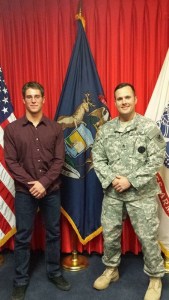
GVSU men’s rugby player brings military background to team

Many students discover what career they want to pursue during their first years in college, but there’s the few that have a different calling: the call to serve their country.

For Ben Serra, a member of the Grand Valley State men’s club rugby team, he knew from a young age the military was an interest.

“Everything I had became a gun like bananas were guns,” Serra said. “When I was in elementary school, my mom gave me a summer project to use our sandbox and build a replica of all the different battles from World War II or World War I.”

He wanted to enlist right out of high school, but wanted to make sure it was what he really wanted to do. He knew he wanted to pursue a professional career other than the military at some point in his life, so he decided to attend GVSU.

Serra began his first year at GVSU in the fall 2014 and he wanted to join some sort of club to be a part of the community. Rugby was it.

“From the first practice, I loved the atmosphere and the guys there,” Serra said. “It’s a great sport, I’ve loved playing it for a long time.”

He enlisted at the end of his first year in May 2015.

28760_rugby_rgb01f
Courtesy of Ben Serra

“My parents were very supportive in my decision,” Serra said. “They knew it was something I had always aspired to become a part of, and that it would be a huge benefit to me.”

He was sent to Fort Benning in Georgia in mid-October of 2015 for his One Station Unit Training, which is basic training and infantry school combined.

“I saw it coming, it was a long process so I was able to get mentally ready for it, but it was still really strange,” Serra said. “It was two completely different worlds that I was in.”

While at basic training, they were usually called “warriors” since they’re not technically soldiers yet. But the sergeants still want to instill a sense of pride in them.

The days at Fort Benning were usually 17 hour days starting at 4:15 a.m. By 5 a.m. the beds were made, morning routines finished, and dressed for physical training. They completed some sort of physical training like running, upper or lower body, or abdominal exercises.

After physical training, they switched into their uniforms and headed to breakfast at seven a.m. Following breakfast, they got their gear ready for training. Training consisted of either heading to a range to shoot or practice tactics.

They ate lunch at the range and finished training around 4 p.m. Dinner was at 5 p.m. To end the day, they usually cleaned their weapons, completed classroom work or cleaned equipment for the next day. Lights out was promptly at 9 p.m.

“Along with Army tactics and customs, it taught me discipline, teamwork, confidence, physical toughness, mental fortitude, and critical-thinking skills that I don’t think I could have acquired anywhere else,” Serra said.

This training varied if there was something specific they needed to work on. The weekends warriors had off to rest up but they were not allowed to leave.

Serra completed training mid-February 2016 at the top of his class, which means he consistently put extra effort into making sure the platoon is taken care of, great physical training test scores and an understanding of the infantry’s role in combat.

Not only did he come back home to the friends made prior to camp, but he was leaving the ones he made at Fort Benning.

28759_rugby_rgb00f
Courtesy of Ben Serra

“Because you’re in such a stressful environment for so long and you’re living so closely with a lot of guys,” Serra said. “I have a couple friendships that are going to be definitely lasting friendships just because of that bond.”

Now Serra’s unit is the 1-125th Infantry in the Michigan Army National Guard. He has four and a half years left on a six year contract and still attends drill weekends once a month where they continue their training. For drill weekends, his home-station is either south of Grand Rapids at the Grand Valley Armory or Camp Grayling.

Training is at it’s all time high during the summer to prepare the men in the unit since it is most convenient for them because most are like Serra and in school. During the fall and winter, training slows down.

“It’s like a rebuilding time of the year for us,” Serra said. “Mostly just learning like military concepts, reacting to certain situations, a lot of medical stuff because that’s easier to train on during the winter.”

Since Serra has been back with GVSU men’s club rugby team, his changes haven’t gone unnoticed.

“The training has helped him in that he is very mentally tough and his conditioning is better than anyone else on the team,” said captain Cam Maher. “I respect and thank anyone who serves our country, but I’m extra proud that my friend has taken on this task.”

Even though Serra went through an experience such as this, he still remains the same person.

“He is always smiling, always working hard, helping his teammates without asking for anything in return,” said teammate Louis Ricard. “He is one of the most caring and giving people, and I am truly lucky to have him as a teammate, but more importantly as a friend.”

He made such an impact on the team, while Serra was away at basic training over the summer the team elected him as club president.

rugby-team
Courtesy of GVSU Men’s Rugby Facebook Page

“Rugby has been a very positive factor in my life,” Serra said. “Like most sports, it has reinforced the necessity of teamwork, communication, the benefits of being physically active, and it provided me a huge social opportunity.”

The team finished the season 6-1. They played their first game of playoffs at Illinois State University on Nov. 12 and lost 17-41.

“We didn’t play as well as we should have,” Serra said. “We made a couple mistakes but that’s something we’re going to grow from and hopefully capitalize on this next season.”

Going into the game, the team did not think their season would end.

“We knew they were going to be a tough team to face,” Serra said. “They’re very beatable and they just came to play and we had a tough time getting things rolling.”

At the end of the fall season, the team elects a new executive board to help run the team until the following fall semester. Serra was elected as the new captain.

“I feel like that’s more of what I want to do on the team,” Serra said. “I like being involved on the field and working on practices and rosters more than administrative paperwork and emails.”

Serra will be the one to greet new people that come to practice or people that visit the school that are interested in playing rugby.

Cam Maher, the last captain, was elected president. With the reversal of roles and being roommates with , Serra thinks it will only benefit the team

“We’re roommates so I mean we’re talking about rugby and what we want to do with the team daily so I think it’s going to be great,” Serra said.

While the competitive rugby season is only in the fall, the executive board meets a few times a semester to discuss administrative things like uniforms, finances, etc. The team uses group messages more often than not, Serra said it’s easier to communicate that way.

The team, also, has friendly matches in the spring to keep the guys in shape. They also use it as an opportunity to invite local high schools to come out and see what rugby is all about.

“We use it more as a recruiting tool and more of a scrimmage,” Serra said.

With all the new renovations and equipment on campus in the recreation center, the team finds new places in the winter to put in some work.

“We rent out the team weight room in the basement of the rec center one or two times a week and then with the new rec center, the renovation, it’s really easy for us to get a lot of guys in there lifting and on the track running,” Serra said. “We also reserve time in the Kelly Center to have actual practice probably going to have that two days a week.”

Serra has noticed that a lot of the players are taking their own initiative and hit the weight room on their own.

But Serra needs to work out more to stay in National Guard shape. His roommates keep him accountable and most of the time they join him.

“My freshman year when I was living with a guy who wasn’t playing rugby it was kind of tough to go to the gym every day or get up early and go for a run, but living with these guys, just being surrounded by that atmosphere and that motivation just makes it way easier on me,” Serra said.

Serra and the rest of the rugby team have a lot of ideas for this upcoming spring season and the following competitive fall season.

“We’re going to try to get things going a little bit earlier this year than we’ve had in the past just because I think it will give us a competitive edge on the field, take things more seriously, have more serious practices,” Serra said. “We’re going to try to have a more intense spring season this year.”

Serra plans to finish out his bachelor’s degree in Business Economics while finishing out his contract with the National Guard, where he could get deployed at any time.